Case study: powder metallurgy
Showing buyers what happens inside a powder metallurgy press and furnace
Allied Sinterings makes miniature precision metal parts. They needed to explain conventional powder metallurgy to engineers and buyers, and the process happens where no camera can go. We built a 6.5-minute 3D explainer that follows the powder from the blender to the finished part.
- Client
- Allied Sinterings, Inc., USA
- Industry
- Powder metallurgy, miniature precision parts
- Deliverable
- 6.5-minute narrated 3D explainer, 18 scenes
- Delivered
- May 2026, after two written revision rounds
The challenge: a process nobody can see
Allied's existing process video was live footage. It showed presses and furnaces from the outside, but the parts that make powder metallurgy valuable happen inside: powder filling a closed die, punches compacting it at 10 to 60 tons per square inch, and particles bonding in a furnace at over 2,000 °F.
They wanted a new version that explained conventional powder metallurgy only, with no metal injection molding or isostatic pressing mixed in, so a buyer could understand why pressed-and-sintered parts come out net-shape and repeatable.
What we built
The project started from an approved script and an 18-scene breakdown timed to the voice-over. Every scene was storyboarded, then modeled and animated as one continuous process. Each scene carries one idea and an on-screen label, so the video also works with the sound off at a trade show.
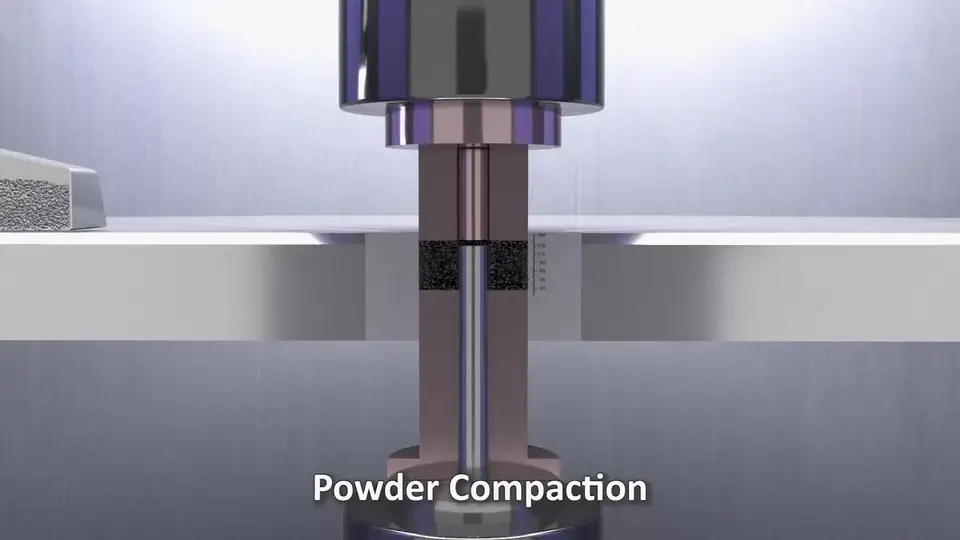
Compaction in cross-section
The feeder shoe fills the die, the lower punch sets the volume, and both punches press the powder into a green compact.
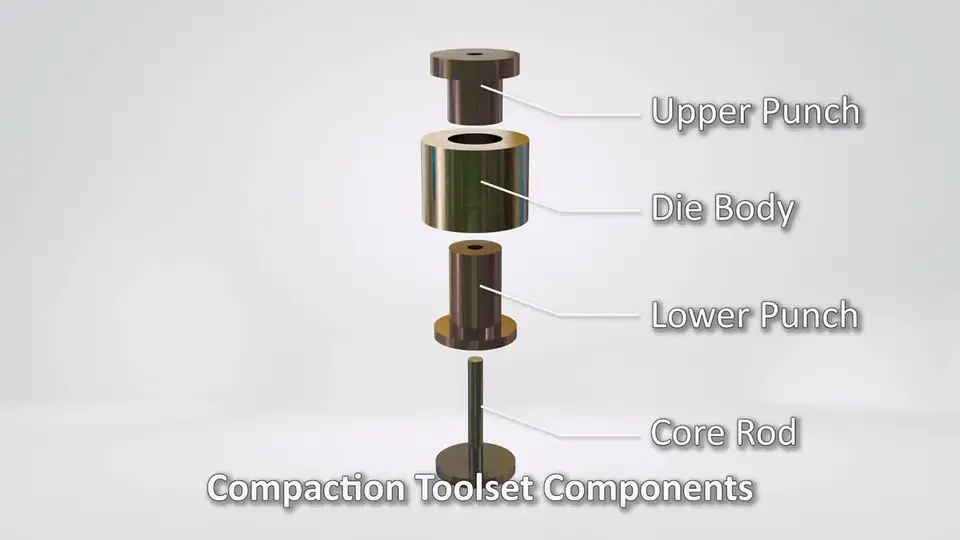
The toolset, exploded
Die body, upper punch, lower punch, and core rod separate and label themselves, then snap back into the running cycle.
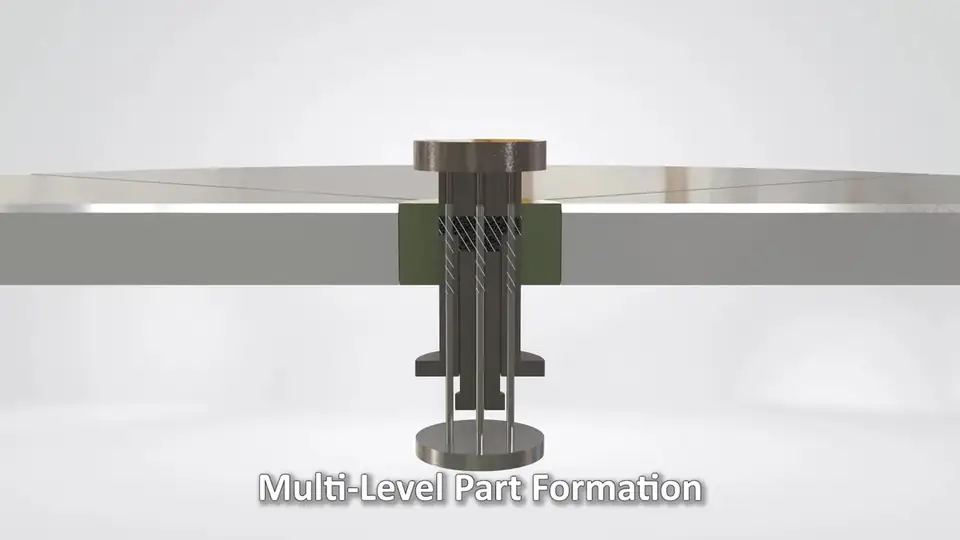
Multi-level tooling
Split punches move independently and core rods form internal holes, so stepped parts come out of the press ready to use.
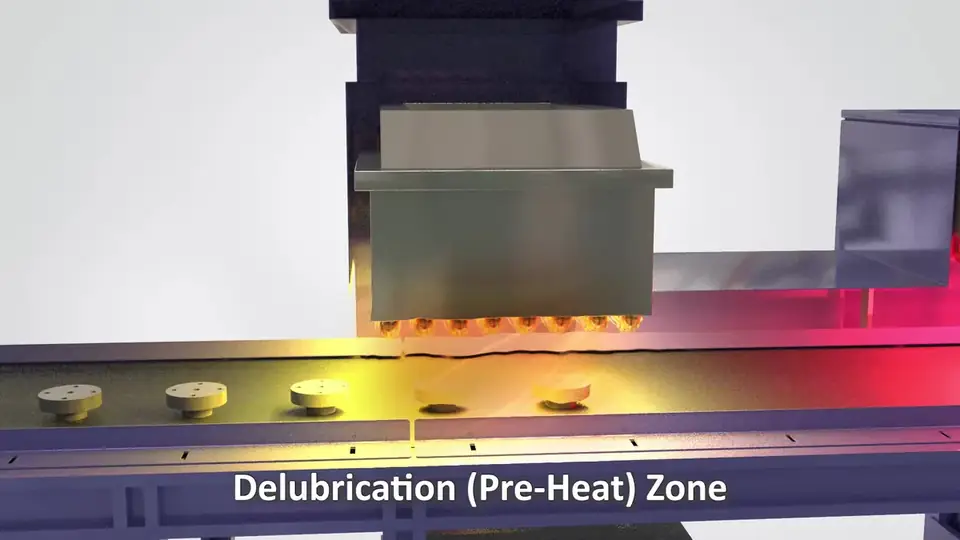
Inside the sintering furnace
Parts ride the mesh belt through delube, high heat, and cooling, with the gas atmosphere and real zone temperatures shown.
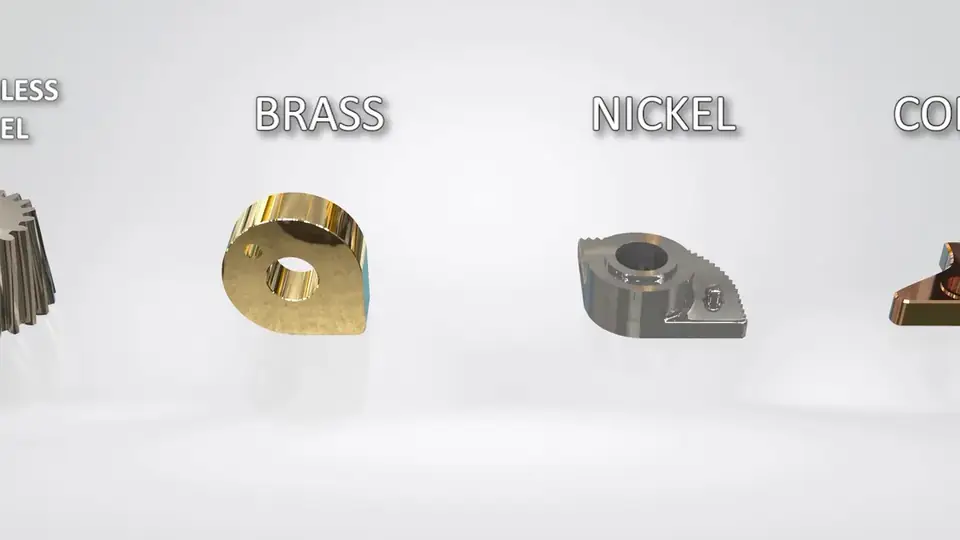
Materials and properties
Iron, stainless steel, brass, nickel, and copper parts, plus tensile testing and oil-impregnated self-lubricating bushings.
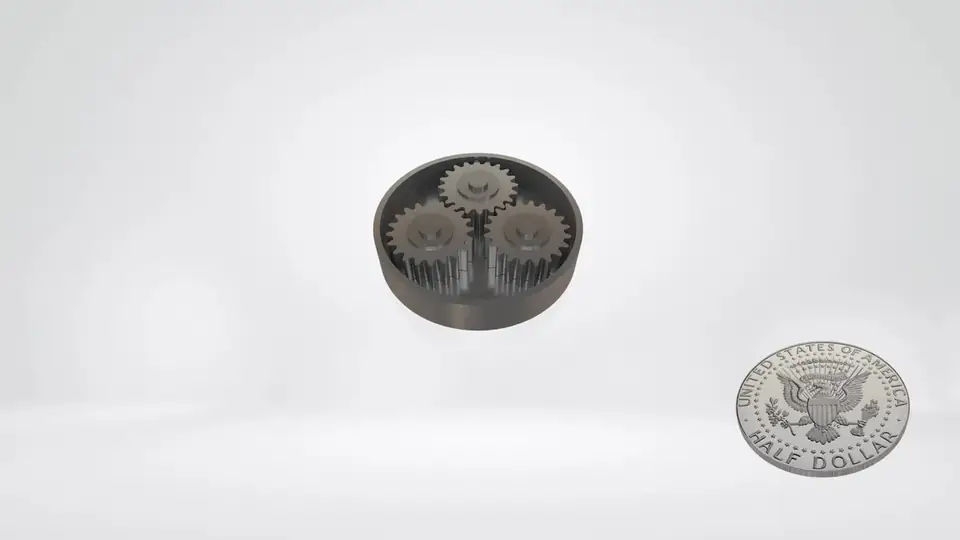
"Nothing bigger than this"
Allied's size limit made tangible: the largest part they press, 1.5 inches across, set next to a US half dollar.
Why 3D animation instead of filming
It goes inside the die
A camera can't see powder fill a closed cavity or two punches meet. A cutaway shows it clearly and can repeat the cycle as many times as the viewer needs.
It shows the invisible
Sintering happens between particles. A microscopic view of particles bonding explains what "metallurgical bonding" means in a few seconds.
It never stops production
No line shutdown, no safety paperwork, no reshoots. The whole video was built from reference photos, drawings, and the client's old footage.
Getting the engineering right
Allied's team knows this process better than anyone, so the review rounds were about accuracy. The first full cut came back with positive feedback and a precise list of corrections, sent in writing. Every item was fixed before delivery. A few examples:
| Their note | What we changed |
|---|---|
| "Our furnace is gas-fired, not electric." | Rebuilt the furnace delube and high-heat sections to match a gas-fired furnace, and kept the heat-wave effect they liked. |
| Core rods must stay level with the top of the die. | Re-animated every core rod shot so the rods hold position through the whole cycle, as they do on a real press. |
| Show real temperatures in °F. | Converted every readout to Fahrenheit with the real process values (1,000 °F and 2,150 °F), and the cooling gauge now drops from 2,000 °F to 70 °F. |
| The gases should fill the whole furnace. | Nitrogen and hydrogen now mix on entry, spread through the chamber, and spill out of both ends of the furnace. |
| Materials and scale must be exact. | Corrected the brass and nickel colors, turned the copper part into a counterweight, and swapped the quarter for a half dollar. |
How the project ran
Everything was handled in writing, from brief to final file. No calls were needed.
- Brief and references. The client's old process video, product photos, furnace drawings, and their engineer's guide to powder metallurgy.
- Script and scene breakdown. Voice-over and 18 scenes, timed and approved before any animation.
- Storyboard. Every scene planned frame by frame and checked against the reference images.
- Animation drafts and revisions. Two rounds of written feedback, each fixed in full.
- Final delivery. A narrated HD video for the website, sales team, and YouTube.
Have a process that's hard to film? Send the details.
Attach drawings, photos, CAD, or your current video and tell us where the animation will be used. You get a clear scope, timeline, and price in writing. Prefer email? Write to design@cobradesigns.net.
Request a written quote- Projects typically start at $1,500
- NDA on request
- Reply within 1 business day